微米级守护:西格数据DBS机床主轴动平衡监测系统,精准识别垫屑与主轴偏心,杜绝模具损伤与整批超差!
公司动态 日期:2026/03/30

在精密加工中,装夹环节的微小异物往往是引发质量问题的“隐形杀手”。一颗不足发丝直径的垫屑残留于零件安装面,便可能导致刀柄与主轴贴合异常,进而引发主轴偏心、动平衡失调,最终在加工中传导为尺寸偏差、表面质量下降甚至模具损伤。这类问题隐蔽性强、爆发突然,传统人工检查与事后检测手段难以在源头形成有效拦截,持续制约着高精度加工的质量稳定性。
针对这一长期被忽视的工艺盲区,西格数据推出DBS机床主轴动平衡监测系统,通过“高频振动感知+微米级垫屑识别+开机自检”的技术闭环,将主轴健康管理从“事后响应”升级为“事前预警”,为精密加工筑起第一道防线。
一、传统主轴装夹管控三大核心困境
在实际机加生产中,垫屑残留、主轴偏心问题长期难以根治,传统管控手段存在无法规避的短板:
❌ 微小垫屑人工识别盲区:人工肉眼或常规擦拭检查仅能清理大尺寸铁屑,而超薄垫屑、粉末碎屑极易残留于主轴锥孔或刀柄贴合面,0.3mm级细微异物完全无法察觉,装夹偏差在高速切削中持续放大振动;
❌ 主轴偏心状态无实时感知渠道:缺少在线动平衡监测手段,主轴安装偏心、残余不平衡量只能依靠事后抽检工件、停机打表检测,加工全程偏心振动持续存在,持续损耗主轴与刀具寿命;
❌ 质量风险滞后爆发,损失不可逆:垫屑引发的偏心振动不会立刻显现问题,往往批量加工后才集中出现尺寸超差、表面振纹;一旦异常成型,批量工件直接报废,同时加剧主轴轴承、刀柄不可逆损耗,产生高额维修与物料成本。
二、智能识别,为机床装一颗“AI大脑”
西格数据DBS机床主轴动平衡监测系统,通过在机床主轴端安装高精度振动传感器,结合多维信号处理与智能分析算法,实现对主轴健康状态的实时监测与异常预警;
✅ 高频振动感知,精准识别主轴异常
系统支持最高4000Hz高频数据采集,并采用高通滤波、共振频带提取、包络谱分析等多维振动特征分析技术,实时判断主轴动态平衡状态。一旦检测到因垫屑引起的偏心或振动异常,系统即时输出预警信号,为操作人员提供明确的处置依据;
✅ 微米级识别垫屑,提前拦截质量风险
针对刀柄装夹过程中产生的微小异物,系统可精准识别≥0.02mm(20微米)超薄垫屑,远超人眼与常规检测手段的分辨极限。发现异常后立即报警并联动停机,有效避免刀柄贴合异常、主轴偏心恶化,从源头杜绝批量质量风险;
✅ 开机智能自检,保障监测过程可靠
系统具备开机前一次性智能自检功能,自动确认传感器连接、信号质量及系统运行条件,确保每一次监测数据的准确性与可靠性,避免因设备状态或采集异常影响判断结果。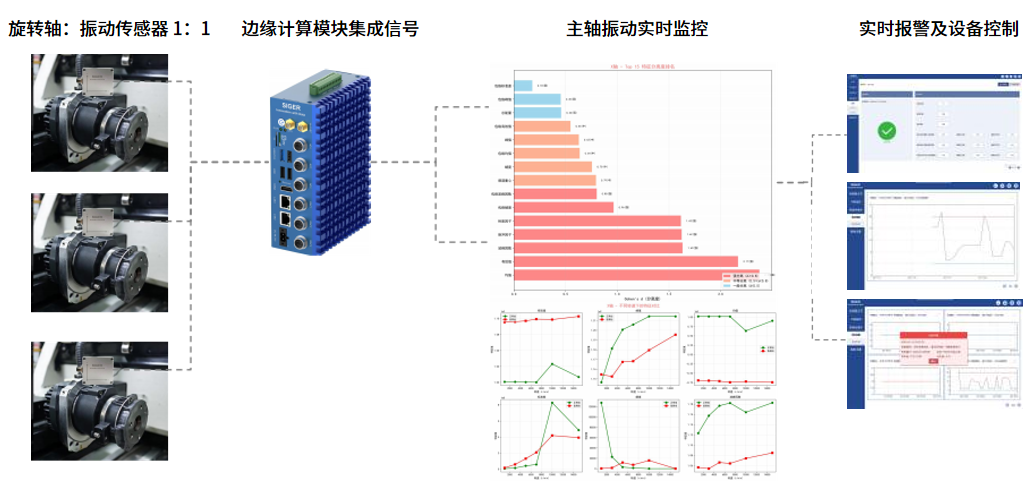
(垫屑识别原理及功能实现图)
三、应用价值:综合效益的全面提升
该系统已在多家高端制造客户现场落地验证了其技术价值,在保障加工质量的同时,显著提升设备健康度与管理智能化水平:
3.1 质量保障
◼ 微米级拦截装夹异物,避免批量尺寸超差与表面振纹;
◼ 杜绝主轴偏心隐患,保障高价值工件与模具加工精度;
3.1 设备保护
◼ 实时监控动平衡,减少主轴偏心引发的异常振动;
◼ 降低轴承与刀柄不可逆磨损,延长机床核心部件寿命;
3.3 效率提升
◼ 提前预警装夹异常,减少因批量报废导致的生产返工;
◼ 降低非计划停机频次,保障连续自动化生产顺畅运行;
3.4 管理升级
◼ 实现装夹环节数字化监控,降低对人工经验检查的依赖;
◼ 支持从单机到产线的系统级智能决策;
◼ 为柔性产线与智能车间提供可靠数据支撑;
四、快速了解西格数据DBS机床主轴动平衡监测系统
西格数据垫屑识别管理,以微米级感知能力,将精密加工的安全防线前移至装夹一刻,让每一把刀柄的贴合、每一次主轴的旋转,都在精准监控之下,为高端制造提供坚实可靠的“精准”守护。
SIGER DBS机床主轴动平衡监测系统适配范围与优势:
部署方式:即装即用,3小时极速完成安装,无需改变现有加工流程,快速融入生产体系;
适用机床类型:广泛适配各类加工中心与数控机床,兼容发那科、西门子、海德汉等主流数控系统;
系统扩展性:支持单机部署与产线级联网监控;基于同一套硬件平台,可无缝扩展集成TMS刀具监控、TCS碰撞保护、AMS效率优化、CMS热误差补偿、PHM健康管理,打造NC Max 6合1综合解决方案。
选择西格数据,助力机加工企业实现降本增效,无忧生产!
如您对西格数据的产品感兴趣,可以拨打电话:189 6235 3927(微信同号),也可以留下您的需求、电话和公司名称,我们会第一时间与您联系。

Micron-level protection: SIGER Datar's Machine Tool Spindle Dynamic Balance Monitoring System accurately identifies slag and spindle eccentricity, preventing mold damage and batch deviations
Company News Date:2026/03/30

In precision machining, tiny foreign objects during clamping are often the "invisible killers" that cause quality problems. A shaving, less than the diameter of a human hair, left on the part's mounting surface can lead to abnormal contact between the tool holder and the spindle, causing spindle eccentricity and dynamic imbalance. This ultimately manifests as dimensional deviations, decreased surface quality, and even mold damage during machining. These problems are highly insidious and erupt suddenly, making it difficult for traditional manual inspections and post-processing checks to effectively intercept them at the source, continuously hindering the quality stability of high-precision machining.
Addressing this long-neglected blind spot in the machining process, SIGER Data has launched the Machine Tool Spindle Dynamic Balancing Monitoring System (DBS). Through a closed-loop technology system combining high-frequency vibration sensing, micron-level chip identification, and startup self-testing, it upgrades spindle health management from "post-event response" to "pre-event warning," building the first line of defense for precision machining.
1. Three Core Challenges of Traditional Spindle Clamping Control
In actual machining production, chip residue and spindle eccentricity are persistent problems that are difficult to eradicate. Traditional control methods have unavoidable shortcomings:
❌ Blind Spot in Manual Identification of Tiny Chips: Manual visual inspection or routine wiping can only remove large-sized chips. Ultra-thin chips and powdery debris easily remain in the spindle taper hole or tool holder contact surface. Tiny foreign objects as small as 0.3mm are completely undetectable, and clamping deviations are continuously amplified by vibrations during high-speed cutting.
❌ Lack of real-time detection of spindle eccentricity: The absence of online dynamic balancing monitoring means that spindle eccentricity and residual imbalance can only be detected through post-processing workpiece sampling and dial indicator checks during machine downtime. Eccentric vibration persists throughout the machining process, continuously shortening the lifespan of the spindle and cutting tools.
❌ Delayed and irreversible quality risks: Eccentric vibration caused by shavings does not immediately manifest as a problem. It often only appears after batch processing, resulting in dimensional deviations and surface rippling. Once abnormal formation occurs, the entire batch of workpieces is scrapped, further exacerbating irreversible wear on spindle bearings and tool holders, leading to high repair and material costs.
2. Intelligent Identification: Equipping Machine Tools with an "AI Brain"
The SIGER Data Machine Tool Spindle Dynamic Balance Monitoring System (DBS) utilizes high-precision vibration sensors installed at the machine tool spindle end, combined with multi-dimensional signal processing and intelligent analysis algorithms, to achieve real-time monitoring and anomaly warning of the spindle's health status.
✅ High-Frequency Vibration Sensing for Precise Spindle Anomaly Identification
The system supports high-frequency data acquisition up to 4000Hz and employs multi-dimensional vibration feature analysis technologies such as high-pass filtering, resonance band extraction, and envelope spectrum analysis to determine the spindle's dynamic balance status in real time. Once an eccentricity or vibration anomaly caused by shavings is detected, the system immediately outputs an early warning signal, providing operators with clear guidance for handling the situation.
✅ Micron-Level Shaving Recognition for Early Interception of Quality Risks
For tiny foreign objects generated during tool holder clamping, the system can accurately identify ultra-thin shavings ≥0.02mm (20 microns), far exceeding the resolution limits of the human eye and conventional detection methods. Upon detecting an anomaly, an alarm is immediately triggered and the machine is shut down, effectively preventing abnormal tool holder contact and spindle eccentricity deterioration, thus eliminating batch quality risks at the source.
✅ Intelligent self-check upon startup ensures reliable monitoring process
The system features a one-time intelligent self-check function before startup, automatically verifying sensor connections, signal quality, and system operating conditions to ensure the accuracy and reliability of every monitoring data point, avoiding the impact of equipment status or data acquisition anomalies on judgment results.

(Diagram illustrating the principle and function of pad debris recognition)
3. Application Value: Comprehensive Improvement of Overall Benefits
This system has been successfully implemented and validated at multiple high-end manufacturing customer sites, significantly improving equipment health and management intelligence while ensuring processing quality:
3.1 Quality Assurance
◼ Micron-level interception of foreign objects during clamping, preventing batch dimensional deviations and surface rippling.
◼ Elimination of spindle eccentricity risks, ensuring the processing accuracy of high-value workpieces and molds.
3.2 Equipment Protection
◼ Real-time monitoring of dynamic balance, reducing abnormal vibrations caused by spindle eccentricity.
◼ Reducing irreversible wear on bearings and tool holders, extending the lifespan of core machine tool components.
3.3 Efficiency Improvement
◼ Early warning of clamping anomalies, reducing production rework due to batch scrap.
◼ Reducing the frequency of unplanned downtime, ensuring smooth operation of continuous automated production.
3.4 Management Upgrade
◼ Digital monitoring of the clamping process, reducing reliance on manual experience inspection.
◼ Supporting system-level intelligent decision-making from single machine to production line.
◼ Providing reliable data support for flexible production lines and smart workshops.
4. Quick Overview of the SIGER Data's Machine Tool Spindle Dynamic Balancing Monitoring System
SIGER Data's Machine Tool Spindle Dynamic Balancing Monitoring System (DBS), with its micron-level sensing capabilities, moves the safety line of precision machining forward to the moment of clamping. Every toolholder's fit and every spindle rotation is under precise monitoring, providing robust and reliable "precision" protection for high-end manufacturing.
SIGER Machine Tool Spindle Dynamic Balancing Monitoring System's Scope of Application and Advantages:
Deployment Method: Plug and play, installation completed in 3 hours, no need to change existing machining processes, quickly integrated into the production system.
Applicable Machine Tool Types: Widely compatible with various machining centers and CNC machine tools, compatible with mainstream CNC systems such as FANUC, Siemens, and Heidenhain.
System Scalability: Supports stand-alone deployment and production line-level network monitoring; based on the same hardware platform, it can be seamlessly expanded and integrated with TMS tool monitoring, TCS collision protection, AMS efficiency optimization, CMS thermal error compensation, and PHM health management, creating an NC Max 6-in-1 comprehensive solution.
Choose SIGER Data to help machining companies reduce costs, increase efficiency, and achieve worry-free production!
If you are interested in SIGER products, you can contact us by phone or email, or submit your requirements by leaving a message, and we will arrange personnel to contact you as soon as possible.
--------------------------------------------------------------------------------------------------------------------------------------------------------
Official Contact Info:
Email: marketing@siger-data.com
WhatsApp: +86 189 6235 3927
WeChat: 189 6235 3927

